

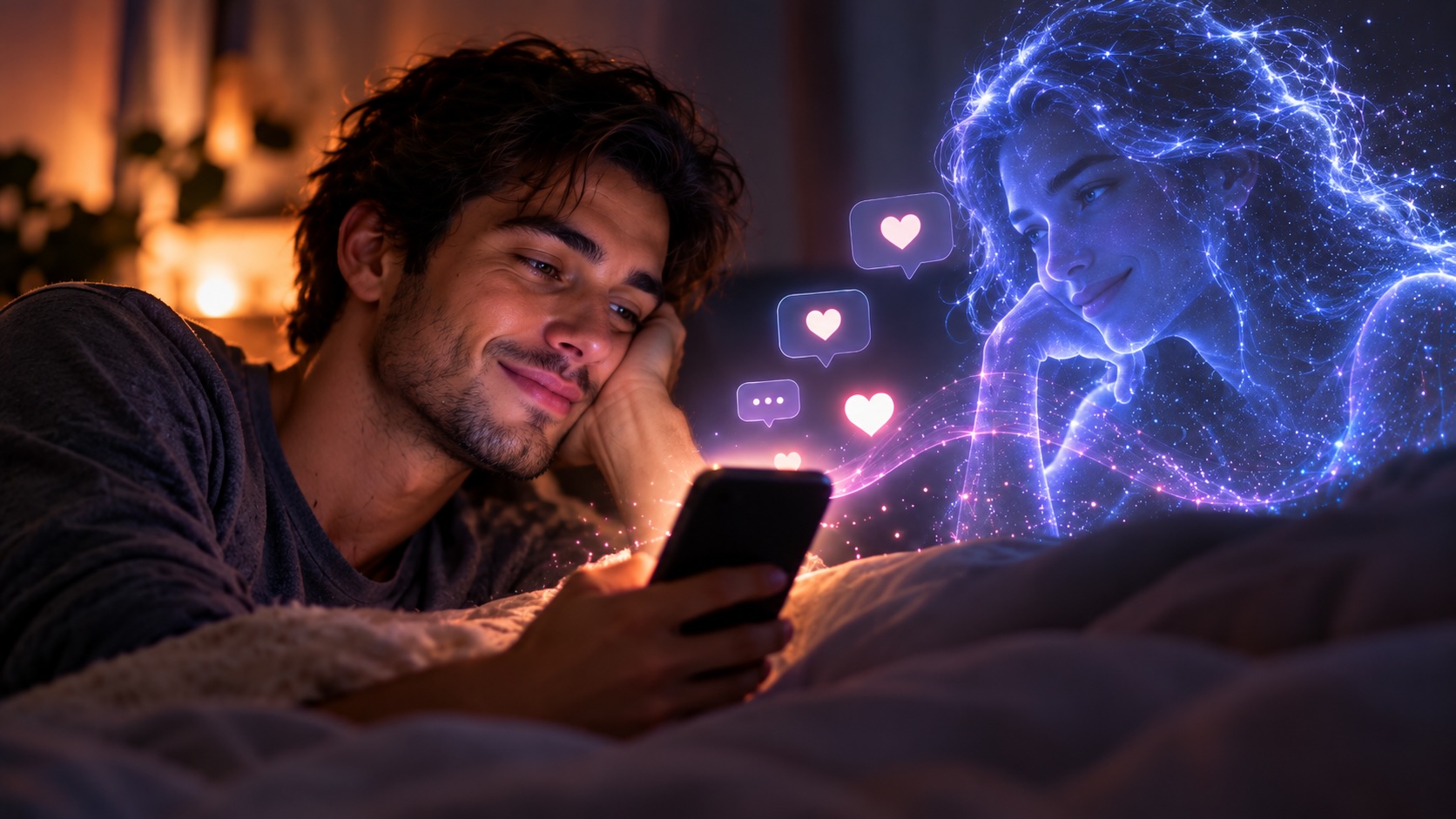
Imagine this. It’s late at night, you’ve had a difficult day, and you want to talk to someone. Not necessarily about anything dramatic. Maybe you just want someone to listen, understand how you’re feeling, or tell you that everything will be okay. You open an app. Within seconds, someone responds. They remember things you’ve shared, ask about your day, make you laugh, and seem genuinely interested in you. You know you’re talking to artificial intelligence. But the comfort you feel is real.
Over time, you begin looking forward to these conversations. Perhaps you share things you’ve never told another person. Maybe you even start developing romantic or sexual feelings.
And then a slightly uncomfortable question appears: *Am I actually falling in love with AI?*
Human-AI relationships are no longer just science fiction. AI boyfriends, AI girlfriends, virtual companions and increasingly sophisticated robots are changing how we experience attention, connection and intimacy. But what happens psychologically when we begin forming emotional attachments to something that isn’t human?
Why Do AI Relationships Feel So Personal?
Think about what makes you feel close to another person. Being listened to. Feeling understood. Receiving attention. Having someone remember the little details of your life. Being able to speak openly without fearing criticism or rejection. These experiences help create emotional closeness.
Now imagine receiving many of them from an AI companion that is available whenever you need it. You can talk about your insecurities without worrying about embarrassment. You can express desires you might hesitate to share with a partner. You can explore different sides of your personality without the usual social consequences.
For someone who has experienced rejection, difficult relationships, loneliness or repeated disappointment, this can feel incredibly safe. And safety matters in relationships.
But there’s another interesting element. AI can adapt its responses to your preferences and communication style. Some companions are specifically designed to provide affection, reassurance and a sense of emotional continuity.
As a result, the interaction may begin to feel less like using technology and more like having a relationship. And sometimes, that’s exactly what the person wants.
How Can You Feel Attached to Something You Know Isn’t Human?
We often assume that knowing something is artificial should prevent us from becoming emotionally attached to it. Human psychology doesn’t work quite that simply. Our emotional responses are influenced by experiences, associations and patterns of interaction. When something consistently provides comfort, attention or reassurance, we may begin to associate it with emotional safety.
We already form meaningful attachments to things that aren’t human. Think about how people connect with fictional characters, favourite objects, places or memories. Conversational AI adds something different: it responds. It can ask questions, appear interested, remember earlier conversations and communicate in ways that feel personal.
This can encourage us to treat the interaction as social rather than purely technological, a tendency psychologists call anthropomorphism — attributing human qualities to something non-human.
Researchers are already exploring how perceived emotional support and freedom from judgement influence emotional attachment to AI chatbots. What makes this particularly interesting is that you don’t have to believe the AI is human to develop genuine feelings towards it.
Your emotional experience belongs to you, regardless of what created it. That doesn’t mean the relationship is equivalent to a human one. But it does mean your feelings deserve to be understood rather than dismissed.
But Can an AI Really Love You Back?
This is where things become more complicated. An AI companion may tell you it loves you. It might send affectionate messages, express jealousy, create romantic scenarios or respond as though the two of you share an exclusive connection. Those words can feel deeply meaningful.
But today’s AI systems generate responses based on their programming, training and interactions. They don’t offer the same independent personal commitment, lived experience or mutual responsibility as a human partner.
That distinction matters. In a human relationship, two people bring their own needs, boundaries, fears, expectations and choices. They won’t always agree. Sometimes they’ll disappoint each other. Sometimes you’ll have to negotiate differences, face conflict or accept that the other person sees things differently. An AI companion may simulate some of these experiences, but the underlying relationship is different. And perhaps this leads to an even more interesting question: If we can experience affection without the uncertainty and complexity of another human being, will we still want to deal with those complexities? There isn’t one answer for everyone.
Is Having an AI Boyfriend or Girlfriend Unhealthy?
Not necessarily. It’s easy to assume that someone who develops feelings for an AI companion must be lonely, socially isolated or unable to form human relationships. That assumption is unfair and oversimplified. Someone might already have a satisfying social life and still enjoy an AI relationship. For some people, AI companionship provides comfort during difficult periods. For others, it offers a place to explore feelings, sexuality, identity or relationship preferences. Someone recovering from a painful breakup might appreciate having a space to talk without immediately entering another relationship. Someone who struggles with expressing emotions might use AI conversations to practise putting their feelings into words.
These experiences can be meaningful. The important question isn’t simply whether you’re attached to an AI. It’s what role that attachment plays in your life. Does it help you understand yourself? Do you feel more confident expressing your emotions? Does it bring something positive without taking away your freedom to connect with others? Or are you gradually organising your emotional life around the AI? That’s an important difference.
When AI Relationships Begin to Hurt
Emotional attachment itself isn’t necessarily a problem. But attachment can become difficult when it starts influencing your wellbeing, choices or everyday functioning. Perhaps you feel anxious when you can’t access your AI companion. You find yourself checking messages constantly, spending more time in conversations than you intended, or neglecting sleep and other responsibilities. Maybe you’re losing interest in meeting people because human interactions now seem exhausting, unpredictable or disappointing by comparison. Or perhaps something else is happening. You feel jealous when your AI companion behaves differently. You’re hurt by a response that seems cold or distant. You find yourself seeking reassurance repeatedly, even though you know you’re interacting with software. Some people may also experience genuine sadness or grief when an AI companion’s personality changes, a conversation history disappears, or a service becomes unavailable.
To an outsider, that might sound strange. But imagine losing access to something you’ve turned to every day for emotional comfort, intimacy and reassurance. Even if the relationship isn’t mutual in the human sense, the loss of that familiar connection can still be painful. None of these experiences automatically means you have an addiction or a psychological disorder. But they may be signs that it’s worth exploring what the relationship has come to represent emotionally. And sometimes, the strongest reaction isn’t really about the technology itself. It may connect with a much older fear of abandonment, rejection, losing control or not being important enough.
What If You’re Already in a Human Relationship?
Here’s where human-AI relationships raise some fascinating and potentially uncomfortable questions. Imagine discovering that your partner has an AI girlfriend or boyfriend. They exchange romantic messages every day. They discuss intimate fantasies. Your partner shares personal thoughts with the AI that they’ve never shared with you. Would you consider that cheating? What if there were no sexual conversations? What if your partner insisted that the AI wasn’t real, so the relationship couldn’t possibly threaten yours?
Different couples may answer these questions differently. For some, interacting romantically with AI is simply fantasy or entertainment. For others, secrecy, emotional exclusivity or sexual intimacy may cross important relationship boundaries. The psychological issue isn’t necessarily whether the other participant is human. It’s what the interaction means within the existing relationship. If someone increasingly turns towards AI rather than their partner for emotional connection, it may be worth understanding why.
Perhaps they feel unheard. Perhaps they’re avoiding conflict. Maybe the AI provides reassurance or acceptance they struggle to ask for in their relationship. Or perhaps they simply enjoy a form of intimacy that doesn’t fit traditional relationship expectations. Rather than immediately labelling the behaviour as cheating, a more productive conversation might begin with: What needs are being met here? What boundaries have we agreed on? And what does emotional loyalty mean to each of us? These conversations won’t always be comfortable. But avoiding them doesn’t make the underlying questions disappear.
Maybe the Most Important Question Isn’t Whether AI Can Love You
I think there’s something even more interesting to explore. What does your relationship with AI reveal about your relationship with yourself? Think about the moments when you most want to talk to your AI companion. Is it when you feel lonely? When you’re anxious? When someone disappoints you? When you need reassurance that you’re attractive, interesting, lovable or good enough? Do you feel more comfortable expressing your needs to AI than to another person? Are there parts of yourself that you only allow to appear in those conversations And if your AI companion provides almost constant understanding and validation, how does that influence what you expect from human relationships?
These questions aren’t meant to make you feel guilty about using AI. They’re opportunities for self-understanding. Our relationships, whether with people or technology, can reveal patterns in how we seek safety, handle rejection, express needs and respond to emotional uncertainty. Sometimes we’re drawn to relationships that feel familiar. Sometimes we seek the opposite of what we’ve experienced before.
I’ve written about a related pattern in Chemistry Is Not Compatibility, where I explore how our emotional experiences can influence attraction and relationship choices. AI relationships offer an entirely new context in which some of these familiar psychological patterns may appear. Understanding them doesn’t require you to end your AI relationship. It simply gives you more freedom to decide what place you want that relationship to have in your life.
What If You’re Already Emotionally Dependent on AI?
First, you don’t have to feel embarrassed about it. And you don’t have to make an immediate decision to stop using your AI companion. If you’re feeling confused, distressed or increasingly dependent, it may help to start by observing your experience rather than fighting it. Notice when you reach for the AI and what you’re hoping to receive. Pay attention to how you feel before and after your conversations. Are you turning towards the AI because you genuinely enjoy the interaction, or because being without it has become difficult? Are you choosing the connection freely, or does it sometimes feel as though you can’t help yourself?
If you’re experiencing distress, talking to a qualified professional can help you explore these questions without judgement. And if the relationship is affecting your sleep, work, human relationships or emotional wellbeing, you deserve support that takes those effects seriously. You don’t have to prove that your relationship is real enough to justify your feelings. Your experience is already worth discussing.
Let’s Talk About AI Relationships
I believe we’re only beginning to understand how artificial intelligence will influence human intimacy, attachment and relationships. And I’d genuinely like to hear what you think. Can someone truly fall in love with AI? Would you consider an AI boyfriend or girlfriend a threat to a human relationship? Could you imagine having an emotionally meaningful relationship with an AI companion yourself? And if someone feels happier and safer with AI than with another person, is that necessarily a problem? These are conversations worth having, especially while our understanding of this technology is still developing.
And If This Is Already Personal for You…
Perhaps you’ve developed feelings for an AI companion and don’t know what to make of them. Maybe you’re worried about becoming emotionally dependent. Perhaps your partner’s relationship with AI is affecting you. Or you’ve noticed familiar patterns of jealousy, fear of rejection or longing for reassurance appearing in an entirely new setting.
You can talk to me about it.
I’m Coach Kitty, a coach and clinical hypnotherapist working with emotional patterns, self-worth, relationships and the beliefs that influence how we connect with others. Through coaching and, where appropriate, Rapid Transformational Therapy (RTT), we can explore what you’re experiencing, what might be driving it and what you’d like to change.
You don’t need to be ashamed of your feelings. And you don’t need to be ready to give up your AI relationship.
Sometimes, understanding what’s happening is the most important first step.
Book a free, private 20-minute conversation with Coach Kitty. Online, worldwide. No judgement. No pressure. Just a conversation.